

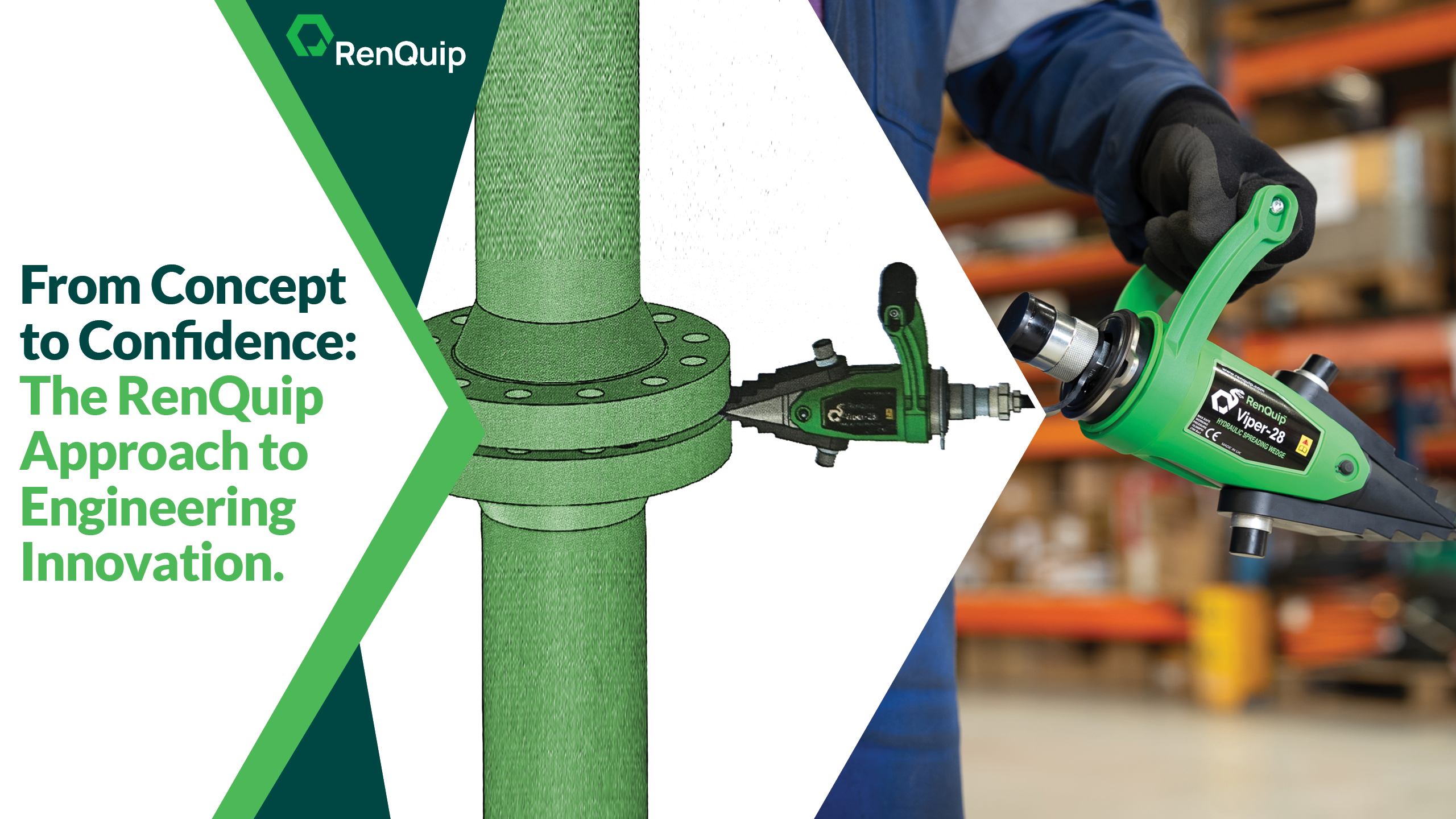
For RenQuip, developing a new tool has never simply been about adding another product to the range. It starts with a problem.
Whether that problem is difficult flange alignment, restricted access, demanding lifting requirements, seized or damaged fasteners, hazardous working environments or the need for a solution that simply does not exist off the shelf, RenQuip’s approach is rooted in understanding the application first and engineering the solution around it.
This philosophy runs through our own engineered and manufactured product range.
The objective is straightforward: develop practical, reliable tools that make difficult jobs safer, simpler and more efficient.
More Than a “Me Too” Product.
From the outset, RenQuip has sought to establish itself as an engineering-led manufacturer rather than simply another equipment supplier. The company’s product development philosophy is based on identifying where existing solutions can be improved, where customers are encountering limitations, and where a different engineering approach could provide a better outcome.
The RHINO range is a clear example.
The RHINO-24P was developed to address the demanding alignment requirements encountered during wind turbine tower construction, where bolt-hole misalignment and flange deformation can create significant installation challenges. The tool combines substantial alignment force with a portable design, using the structure being aligned as part of the reaction system rather than relying on a larger, heavier standalone structure. But the thinking behind RHINO is not unique to one product.
It reflects the wider RenQuip approach: look at the problem from the operator’s perspective, understand the constraints, and then engineer a solution that works in the real world.
Engineering From the Operator’s Perspective.
RenQuip tools are often used in environments where conditions are far removed from those of a controlled workshop. Operators may be working offshore, at height, in confined spaces, in remote locations or around heavy industrial equipment. In these situations, the physical characteristics of a tool can be just as important as its headline performance. Weight, portability, access, handling, reliability and ease of use all matter.
That is why RenQuip’s development process places significant emphasis on practical engineering rather than relying solely on theoretical design. Digital engineering and analysis have an important role to play, but physical prototyping, testing and validation remain fundamental to understanding how equipment behaves under real loads.
That principle can be seen across the RenQuip range, where tools are designed to deliver the required performance without adding unnecessary complexity or weight.
Solving the Problem, Not Just Selling the Tool.
One of the defining characteristics of RenQuip’s approach is that product development does not necessarily stop once a standard tool has been launched. Real-world applications can expose requirements that were never apparent during the original design process. That creates another opportunity: adaptation.
The RHINO-24PLR is one example. When a customer application required greater reach than the standard RHINO-24P could provide, RenQuip’s engineering team adapted the existing platform with a longer wing and extended drop leg. The change introduced additional engineering considerations around moment loading, requiring the hydraulic system to be carefully downrated to maintain the tool’s operational integrity. The resulting solution was developed, validated, manufactured and delivered within the customer’s four-week requirement.
A similar philosophy can be seen in the development of the AT4-1.8K.
A customer required a flange alignment tool capable of fitting M15 bolt holes. Rather than accepting that the existing AT4K could not accommodate the application, RenQuip modified the hook pin from 22mm to 15mm while retaining the required alignment capability.
These examples demonstrate an important distinction. Engineering at RenQuip is not simply about designing a new product. It is about finding a way to solve the problem.
Designed for Real-World Applications.
The RenQuip product range covers a broad variety of applications, but many of the underlying design principles remain consistent.
Flange spreading tools need to provide controlled separation while remaining practical to transport and position.
Alignment tools need to generate significant reaction forces while allowing operators to work efficiently in restricted or difficult locations.
Lifting equipment needs to provide stability, control and confidence when handling heavy components.
Nut splitters need to deal with fasteners that may be seized, corroded or otherwise impossible to remove conventionally.
And in environments where ignition risk is a concern, spark-resistant tooling needs to provide the required mechanical performance while addressing the specific hazards of the application.
RenQuip’s spark-resistant range, for example, includes bronze versions of its hydraulic and mechanical flange spreading solutions, extending the application possibilities of the underlying tool technology.
The individual tools may perform very different functions, but the engineering philosophy remains consistent: understand the application, identify the constraint and develop equipment around the requirement.
Innovation Driven by Experience.
Innovation does not always mean inventing something entirely new. Sometimes it means taking an established principle and applying it differently. Sometimes it means changing the geometry of an existing tool. Sometimes it means developing a new material configuration, adapting a component, reducing weight, improving access or making a tool easier for one person to handle.
And sometimes it means combining existing technologies to create a solution for an application that conventional equipment cannot address.
This is where RenQuip’s experience becomes particularly important.
With in-house engineering capability, the company can respond to application-specific requirements and develop modifications or engineered-to-order solutions rather than being restricted to a fixed off the shelf solutions.
This creates a perfect feedback loop between customers, applications and product development. A challenge encountered in the field can become an engineering opportunity. An adaptation developed for one application can become a new product. And a product developed for one sector can ultimately find applications across many others!
The aforementioned RHINO-24P demonstrates this principle – although engineered with the wind sector in mind, this tool is capable across every sector.
Safety and Reliability Built Into the Process.
For RenQuip, innovation cannot come at the expense of reliability or safety.
The company states that its manufactured tools are produced using high-quality materials and 100% load tested, with durability, safety and low maintenance forming key characteristics of the range.
This is particularly important when tools are being used to manipulate, separate, lift or align large and potentially hazardous components.
The engineering process therefore has to consider more than whether a tool can perform a task.
It must also consider how the operator interacts with it, how it behaves under load, how it will be transported and positioned, and how reliably it can perform repeatedly in demanding environments.
That is why RenQuip’s core values – safety, accountability, excellence and integrity – are closely aligned with its approach to product development.
From Customer Challenge to Product Innovation.
Some of RenQuip’s most valuable developments begin with a conversation. A customer may have a problem that existing equipment cannot solve. A distributor may identify an emerging requirement within a particular market. An engineer may recognise an opportunity to improve an established design. Or an application may expose a limitation that was not previously considered.
The response is the same: understand the requirement, assess the engineering challenge and determine what can realistically be achieved.
This responsive approach is particularly valuable in industries where equipment configurations, access requirements and project conditions can vary significantly. Instead of designing around an assumption that every application will be identical, RenQuip can use its engineering capability to adapt to the application.
The Bigger Picture.
- The RenQuip product range continues to evolve, but the underlying objective remains consistent.
- Develop tools that solve genuine problems.
- Make them practical for the people who use them.
- Engineer them to perform reliably under demanding conditions.
- Test them properly.
- And when a standard solution is not enough, find another way.
The result is a growing range of specialist equipment covering flange spreading, alignment, lifting, nut removal, valve removal and other demanding industrial applications, alongside a wider portfolio of equipment from established partner manufacturers.
For RenQuip, innovation is therefore not defined by how complicated a tool looks or how many products appear in a catalogue. It is defined by what the tool enables the operator to achieve.
From the original concept, through engineering, testing and refinement, to the moment a tool is put to work in the field, the objective is to turn an engineering challenge into a practical solution – and ultimately, into confidence.
That is the RenQuip approach to innovation.
 RenQuip